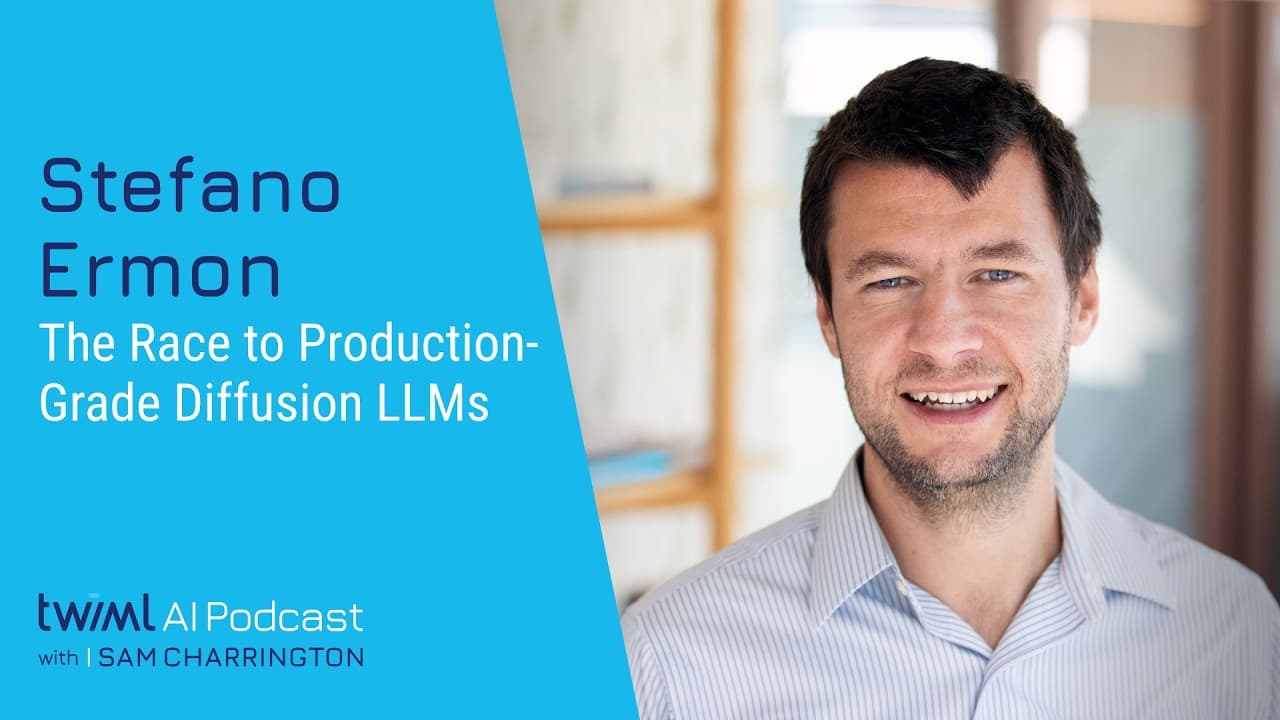
In a recent episode of the TWIML AI Podcast, host Sam Charrington sat down with Stefano Ermon, an Associate Professor at Stanford University and CEO of Inception Labs, to discuss the latest advancements in AI, particularly focusing on the application of diffusion models to language generation tasks.
Who Is Stefano Ermon?
Stefano Ermon is a prominent figure in the AI research community, known for his work on machine learning, probabilistic modeling, and artificial intelligence. As an Associate Professor at Stanford University, he leads a research lab focused on developing novel AI methods for scientific discovery and societal impact. His work spans various areas, including deep generative models, causal inference, and natural language processing. Ermon is also the CEO of Inception Labs, a startup aiming to translate cutting-edge AI research into practical applications.
The full discussion can be found on TWIML's YouTube channel.
![The Race to Production-Grade Diffusion LLMs [Stefano Ermon] - 764 - TWIML](https://img.youtube.com/vi/UDNDOf5hT-A/maxresdefault.jpg)
diffusion models for text generation
The conversation began with a discussion about the recent surge in interest surrounding diffusion models, which have already demonstrated remarkable success in image generation. Ermon explained that the core idea behind diffusion models is to start with random noise and iteratively refine it to generate a coherent output. This process, he noted, can be applied to various data modalities, including text.
Traditionally, language models like GPT-3 and its successors have relied on autoregressive methods, generating text token by token in a sequential manner. While these models have achieved impressive results, they can sometimes struggle with long-range coherence and controllability. Ermon highlighted that diffusion models offer a different approach, allowing for a more holistic generation process.
"The core idea is that you start with random noise, and then you have a neural network that gradually denoises it, essentially guiding it towards a coherent sample," Ermon explained. "This process is repeated multiple times, and at each step, you're essentially making small corrections to the noise to get closer to the target distribution."
He elaborated on how this concept can be translated to text. Instead of pixels, the model works with discrete tokens. The challenge, of course, lies in adapting the continuous diffusion process to the discrete nature of language. Ermon discussed how various techniques are being explored to bridge this gap, including discrete diffusion processes and latent space diffusion.
Advantages Over Autoregressive Models
When asked about the potential advantages of diffusion models over dominant autoregressive models like transformers, Ermon pointed to several key areas. Firstly, he emphasized the potential for improved controllability. "With diffusion models, you have this iterative refinement process, which means you can potentially intervene at different stages and guide the generation towards specific attributes or styles," he stated. This could allow for more nuanced control over the generated text, such as controlling sentiment, topic, or even specific stylistic elements.
Secondly, Ermon touched upon the potential for greater efficiency. While autoregressive models generate text sequentially, requiring each token to be generated based on the previous ones, diffusion models generate the entire sequence in parallel through the denoising steps. "This could lead to faster generation times, especially for longer sequences, and potentially a more globally coherent output," he suggested.
He also mentioned that diffusion models might offer better sample quality in certain scenarios, potentially avoiding some of the repetition or nonsensical outputs that can occasionally plague autoregressive models. "The iterative refinement process allows the model to explore the output space more thoroughly and converge on higher-quality samples," Ermon hypothesized.
Challenges and Future Directions
Despite the promising potential, Ermon acknowledged that applying diffusion models to text generation is still an active area of research with significant challenges. The discrete nature of text, as mentioned earlier, poses a unique hurdle. Additionally, the computational cost of the iterative denoising process, while potentially offering faster inference than some autoregressive models, can still be substantial, especially for very large models.
"One of the main challenges is adapting the continuous denoising process to discrete tokens. We're exploring various techniques, but it's an ongoing research problem," Ermon admitted. "Also, while inference can be faster, training these models can still be quite computationally intensive."
Looking ahead, Ermon expressed optimism about the future of diffusion models in NLP. He highlighted ongoing work at his lab and elsewhere to improve the efficiency, controllability, and overall performance of these models for text generation. The potential to generate more creative, coherent, and controllable text makes this a particularly exciting area of AI research.
Inception Labs' Work
Ermon also provided an update on the work being done at Inception Labs. He mentioned that the company is actively developing large language models based on the diffusion paradigm, aiming to bring these advancements to real-world applications. "We've been working on scaling these models and exploring their capabilities across various tasks, from text generation to summarization and translation," he said. "Our goal is to build models that are not only powerful but also efficient and controllable for practical use cases."
He specifically mentioned the recent release of their model, Mercury 2, which he noted has shown significant improvements in text generation quality and efficiency compared to previous iterations. "We're seeing really promising results with Mercury 2, and we're excited about its potential to push the boundaries of what's possible with language models," Ermon concluded.
The discussion underscored the rapid evolution of AI, with diffusion models emerging as a significant new paradigm that could reshape how we think about and build language generation systems.