In a recent video, Garry Tan, President & CEO of Y Combinator, showcased four open-source AI projects that he believes represent the future of human-AI interaction and business automation. The projects, including gstack, Hermes Agent, and Paperclip, offer a glimpse into a future where AI agents are not just tools but integrated components of a company's operational infrastructure. Tan, a seasoned investor and entrepreneur with a deep understanding of the startup ecosystem, highlighted how these projects are pushing the boundaries of what's possible with AI, particularly in the realm of autonomous agents.
Garry Tan's Vision for AI Agents
Tan, who has invested in and seen thousands of startups, including giants like Coinbase, Instacart, and Airbnb, brings a wealth of experience to his analysis of emerging technologies. He frames the current AI landscape as being on the cusp of a significant revolution, driven by the development of sophisticated AI agents. He quotes Andrej Karpathy, who noted that the pace of AI development has shifted dramatically, with individuals now able to accomplish tasks previously requiring large teams.
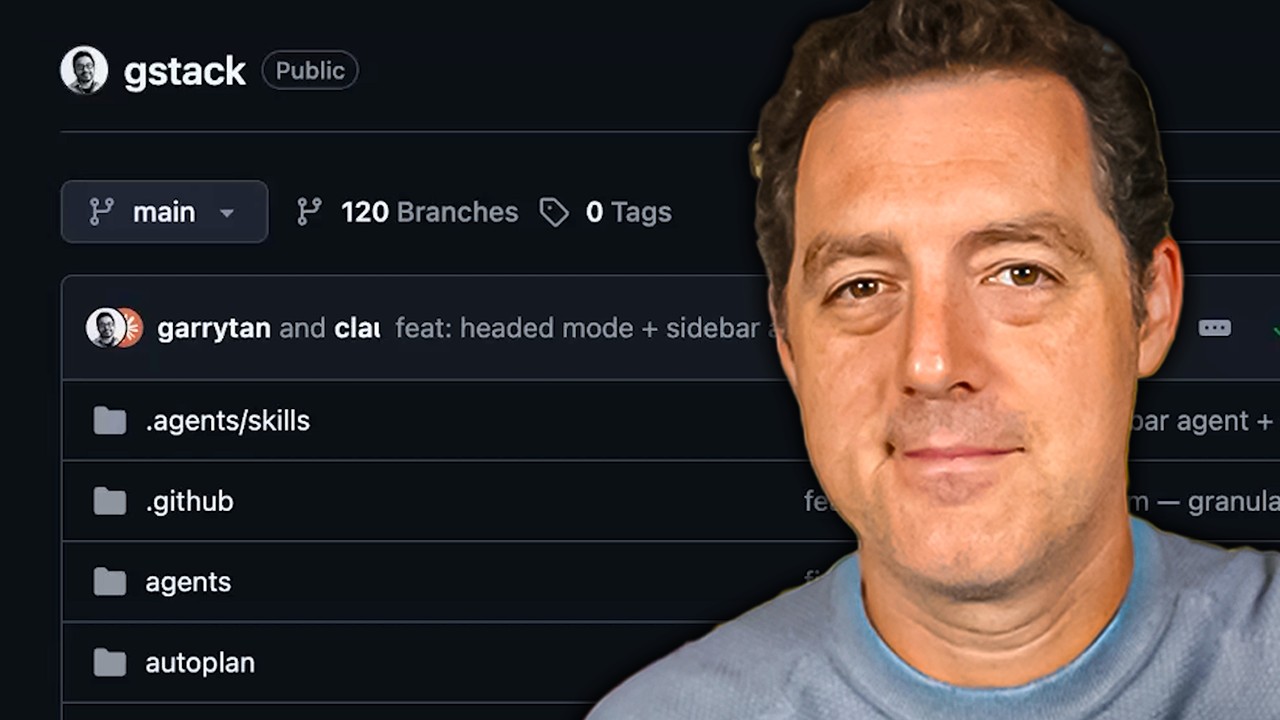
Tan's presentation focuses on projects that embody this shift, specifically highlighting gstack. He describes gstack as a framework for orchestrating AI agents, allowing them to work together on complex tasks. The project, which has rapidly gained traction on GitHub with tens of thousands of stars, is presented as a way to leverage the power of AI agents for a wide range of applications, from web browsing and task automation to more complex workflows like design consultation and code review.
Key AI Agent Projects Explored
gstack: The Orchestration Framework
Gstack, developed by @garrytan, is presented as a foundational tool for building and managing AI agents. Tan emphasizes its open-source nature and its ability to integrate with various AI models and endpoints. The framework offers a suite of pre-built 'skills' that agents can utilize, allowing for modularity and extensibility. The installation process is described as straightforward, with a quickstart guide provided for immediate use. Tan demonstrates how gstack can be used to chain together different skills, enabling agents to perform complex, multi-step tasks autonomously.
Hermes Agent: The Self-Improving AI
Hermes Agent is highlighted as an AI agent built by Nous Research that focuses on a built-in learning loop. Its core functionality involves creating skills from experience, nudging itself to persist knowledge, and searching its own past conversations. The agent is designed to build a deepening model of the user it interacts with, running across sessions and leveraging a GPU cluster or serverless infrastructure. Tan notes its viral growth on GitHub, indicating strong community interest. The agent's ability to self-improve and adapt based on interactions is presented as a key differentiator.
Paperclip: Orchestration for Zero-Human Companies
Paperclip is described as an open-source orchestration system for 'zero-human' companies. If OpenCLaw is the employee, Paperclip is presented as the company. It functions as a Node.js server and React UI that orchestrates a team of AI agents to run a business. Users can bring their own agents, assign goals, and track their work and costs from a single dashboard. Tan likens it to a task manager, but one that under the hood manages organizational charts, budgets, governance, goal alignment, and agent coordination. The project is designed to manage business goals without requiring pull requests, streamlining operations.
Superpowers: A Development Workflow
Superpowers is presented as a complete software development workflow for coding agents. Built on top of composable 'skills' and initial instructions, it guides agents through a development process. Tan explains that when an agent is fired up, it doesn't just jump into writing code; instead, it steps back, asks what the user is trying to do, and then creates an implementation plan. This approach emphasizes principles like Test-Driven Development (TDD), YAGNI (You Aren't Gonna Need It), and DRY (Don't Repeat Yourself). The workflow includes stages like brainstorming, using Git worktrees, writing plans, subagent-driven development, test-driven development, code review, and finishing/branching.
The Broader Implications for AI Development
Tan's presentation underscores a significant trend in AI: the move from isolated tools to integrated, autonomous systems. These projects demonstrate a growing capability for AI agents to not only perform tasks but also to learn, adapt, and coordinate with each other to achieve complex goals. The open-source nature of these projects is crucial, fostering collaboration and accelerating innovation in the field. Tan's insights suggest that the future of AI in business will involve orchestrating teams of specialized agents, managed through intuitive frameworks, to drive efficiency and unlock new possibilities.
Key Features and Future Outlook
The projects showcased offer a range of features designed to empower developers and businesses. These include:
- Bring Your Own Agent: The ability to integrate any agent, in any runtime, with the org chart.
- Goal Alignment: Agents are aligned with the company mission, understanding what to do and why.
- Heartbeats: Agents wake on a schedule, check work, and act, with delegation flowing up and down the org chart.
- Cost Control: Monthly budgets per agent, with no runaway costs if limits are hit.
- Multi-Company: One deployment can manage many companies with complete data isolation.
- Ticket System: Every conversation is traced, with full tool-call tracing and immutable audit logs.
Tan concludes by emphasizing that these are highly experimental and cutting-edge projects, but they offer a compelling vision of the future of work with AI.