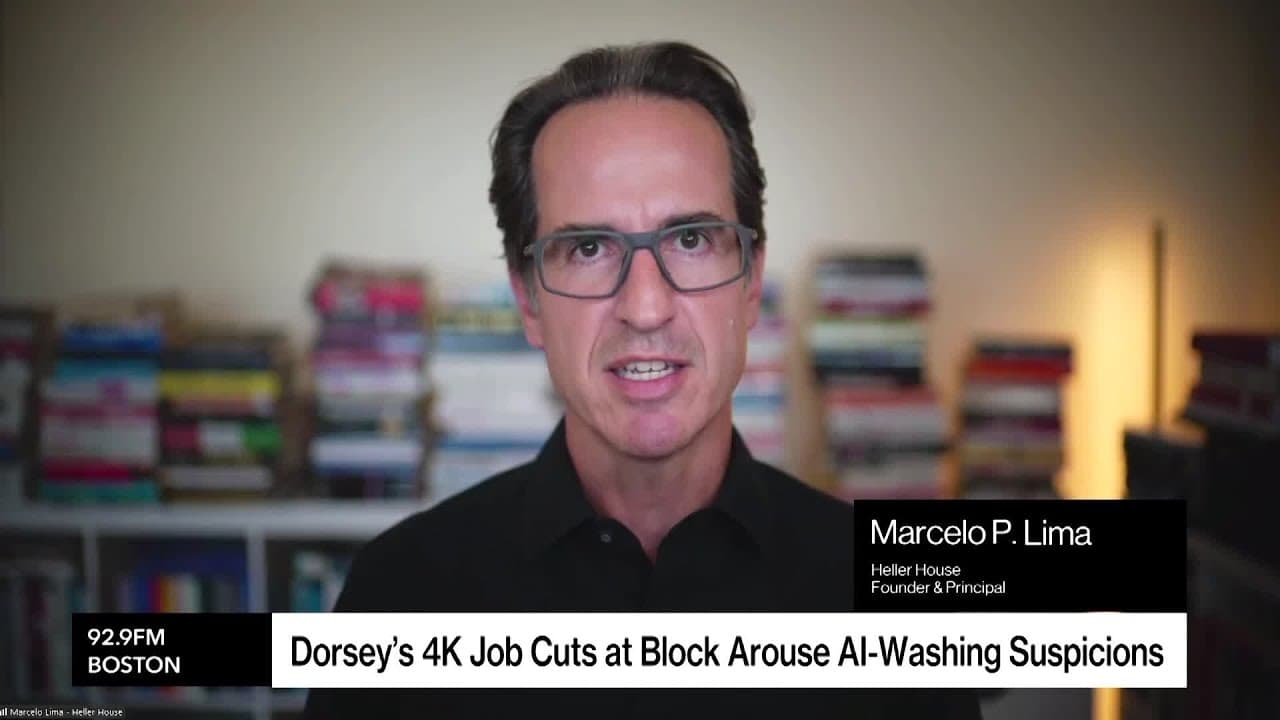
In a recent appearance on Bloomberg Businessweek Daily, Marcelo P. Lima, Founder & Principal at Heller House, offered a critical perspective on Block Inc.'s recent announcement of a 40% workforce reduction. Lima contends that the narrative surrounding AI as the primary driver for these layoffs is a misdirection, suggesting that the cuts are more indicative of the company's long-standing issues with overstaffing and organizational complexity.
Who Is Marcelo P. Lima?
Marcelo P. Lima is a recognized figure in the financial and technology sectors, known for his expertise in analyzing company performance and market trends. As the Founder and Principal of Heller House, he leverages his background as a former software engineer to provide deep insights into the operational and financial health of businesses, particularly within the fintech and enterprise software spaces. His commentary is often sought after for its data-driven approach and critical evaluation of corporate strategies.
The AI-Washing Allegation
The conversation was sparked by Block's recent announcement of significant layoffs, which the company alluded to as being partly related to efficiency improvements. However, Lima expressed skepticism about this explanation. He drew a parallel to Jack Dorsey's tenure at Twitter, where a substantial reduction in workforce following Elon Musk's acquisition was seen by some as a move that improved the product and efficiency. Lima stated, "Block 40% RIF is the new Citrini fake narrative. Everyone will assume Jack Dorsey 'greatest of all time' is doing this because of AI. He's not. Block has been massively bloated for years..." He further elaborated that while AI can indeed make companies more efficient, attributing these specific cuts solely to AI adoption overlooks the company's foundational operational challenges.
The full discussion can be found on Bloomberg Podcast's YouTube channel.
Block's Financial Performance and Operational Inefficiencies
Lima presented data suggesting that Block's operational structure has been inefficient for years. He noted that even after the recent layoffs, the company's employee count remains significantly higher than it was in 2019. "I think it's hard to argue that this company was not massively bloated," Lima commented. He contrasted Block's profit margins with those of its competitors, indicating that Block's operating expenses, including R&D, administrative costs, and marketing, have been eating into its profits. He highlighted that companies like NuBank and StoneCo, operating in similar fintech sectors, have demonstrated much higher profit margins and greater efficiency.
Lima pointed to the company's historical financial performance, showing a trend where operating expenses have often grown faster than gross profit. He suggested that the company's decision to build two separate company structures, Square and Cash App, rather than a unified one, contributed to this bloat. While this was corrected mid-2024, the complexity and associated costs remained.
Investor Expectations and Market Signals
When asked about investor sentiment, Lima suggested that while short-term stock price movements can be noisy, the underlying financial performance is what truly matters. He emphasized that investors are looking for companies that can deliver strong earnings per share and healthy profit margins. He stated, "Investors actually want to see... earnings per share growth... I think Block was poorly performing and they moved on." He also noted that the projected earnings for the upcoming year for Block were not particularly strong compared to its peers, which might have further contributed to the need for significant restructuring.
Lima concluded by advocating for a more nuanced approach to evaluating companies like Block. He suggested that investors should look for businesses that can not only innovate but also execute efficiently and manage their capital effectively. He stated, "If they can do both things, be a product visionary, be good at executing and be good stewards of shareholder capital, then this company could do extremely well." He believes that while Dorsey is a visionary, his past operational decisions at Block have led to the current need for drastic measures.