In a recent appearance on Bloomberg Tech, Peter Ludwig, CTO of Applied Intuition, discussed the company's role in advancing physical AI applications. Applied Intuition specializes in providing the software infrastructure necessary to develop, test, and deploy AI-powered systems. Ludwig highlighted the company's journey from its origins in the automotive sector, particularly in self-driving technology, to its expanding presence in defense and other complex industries.
Peter Ludwig: Visionary CTO
Peter Ludwig serves as the Chief Technology Officer at Applied Intuition, a company at the forefront of developing simulation and data management tools for autonomous systems. With a background rooted in the complexities of building and scaling AI for real-world applications, Ludwig brings a deep understanding of the technical and regulatory challenges involved. Applied Intuition's mission is to accelerate the development and adoption of AI across critical sectors, including autonomous vehicles, robotics, and defense.
Bridging Commercial and Defense AI
Ludwig explained that Applied Intuition's core technology, developed for the demanding requirements of autonomous vehicles, is highly transferable to other domains. "We provide the infrastructure layer for physical AI," Ludwig stated. "This includes the complete software stack that enables machines to move, from cars to trucks, to mining and construction equipment, and then drones and boats." This broad applicability allows the company to leverage its expertise across diverse markets.
The full discussion can be found on Bloomberg Podcast's YouTube channel.
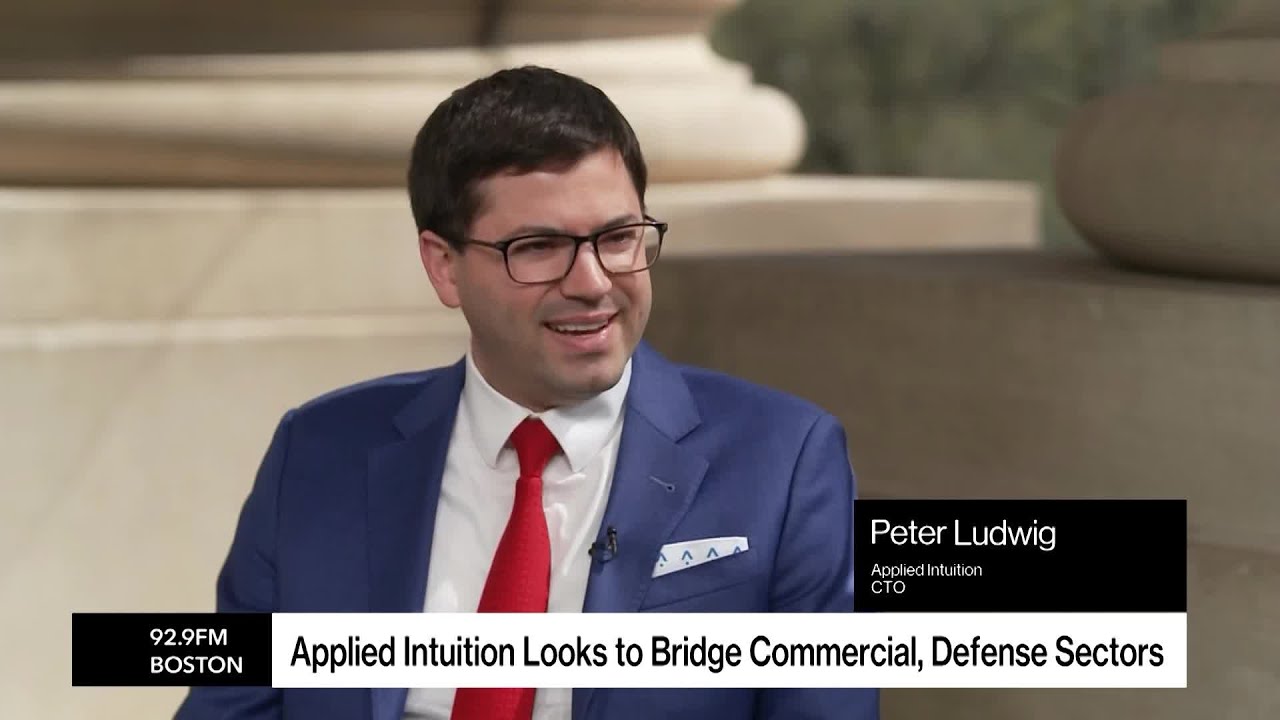
The conversation emphasized the growing synergy between commercial and defense applications of AI. Ludwig noted that the same underlying technologies used for self-driving cars are proving valuable in defense contexts. "We do work with the Navy, deploying the same kinds of data collection technologies that we use for self-driving cars on Navy ships," he said. This includes simulation testing, which Applied Intuition terms a "virtual proving ground." This approach allows for rapid iteration and validation of complex AI systems without the need for extensive real-world testing, which can be time-consuming and costly, especially in sensitive defense applications.
The "Virtual Proving Ground" Advantage
Ludwig elaborated on the concept of the virtual proving ground, explaining its significance in accelerating development cycles. He highlighted instances where commercial projects that might have taken a year to test in the real world could be simulated and validated in days using Applied Intuition's platform. This accelerated pace is particularly critical in the defense sector, where rapid deployment of advanced capabilities is often a strategic imperative. "We've seen similar things where things that might have stalled for even a year or so have been unblocked," Ludwig remarked, underscoring the efficiency gains.
Scaling AI for Autonomous Systems
The discussion touched upon the challenges of implementing AI across various physical platforms. Ludwig pointed out that the complexity of integrating AI software with diverse hardware is a significant hurdle. "The hard part is actually getting this technology deployed into the real world and solving all of those difficult problems that happen when you're really making use of these systems," he explained. This includes ensuring the reliability and safety of AI in dynamic and unpredictable environments.
Applied Intuition's strategy involves building a robust software stack that can be adapted to different hardware, allowing for a more streamlined and efficient deployment process. Ludwig mentioned their work with "18 of the top 20 automakers," indicating their significant traction in the commercial autonomous vehicle space. This extensive experience provides a strong foundation for their expansion into other industries.
The Need for Unified Policy
A key point raised during the conversation was the regulatory landscape for autonomous technologies. Ludwig expressed that the current state of regulation is often fragmented, with different rules and requirements varying from state to state. This patchwork approach can hinder the scaling of autonomous systems, particularly for applications like long-haul trucking that cross multiple jurisdictions. "There is strong need for federal policy to streamline the deployment of autonomous systems," Ludwig stated, emphasizing that a unified national framework would be more efficient and effective than the current state-by-state approach.
This regulatory fragmentation also extends to other areas of physical AI, such as robotics. Ludwig noted that while progress in areas like autonomous vehicles has been significant, the development of humanoid robots in industrial settings, for instance, still faces regulatory considerations. He suggested that a more standardized approach to AI safety and deployment would benefit the entire ecosystem.
Applied Intuition's Competitive Edge
When asked about what makes Applied Intuition's technology superior, Ludwig emphasized the company's focus on providing a foundational infrastructure rather than just a specific AI model. "We're a technology company. We focus on building the technology," he said. "We're not a policy company, we're not a political company." This focus allows them to build the best possible tools for simulation, data management, and testing, which are essential for any company developing physical AI.
Ludwig highlighted that Applied Intuition's strength lies in its ability to create a "virtual proving ground" that is adaptable and scalable. This allows clients to test and validate their AI systems across a wide range of scenarios, leading to faster development cycles and more robust deployments. "We've been working in this domain for quite a long time now, for nearly a decade," Ludwig mentioned, underscoring the company's deep experience and established presence in the field.
He further elaborated on the advantages of their simulation platform by contrasting it with other approaches. "When you look at what NVIDIA is doing, they're now wading into the physical AI space, you know, with inference chips that are good at the edge, their own software stack, libraries, and catalogs of custom models," Ludwig explained. "We feel that the technology stack that we've built, and the ability to actually get this technology deployed, and solving all of those difficult problems that happen when you're really making use of these systems, is what differentiates us."
The Future of Physical AI and Regulation
Looking ahead, Ludwig expressed optimism about the future of physical AI, while also acknowledging the ongoing need for thoughtful regulation. He believes that a unified approach to policy and regulation is essential for the widespread adoption of autonomous technologies. "We want to make sure that we have the best technology available, and that technology is deployed," he stated. "And I think that through our ordinary political process and democracy, that's how we'll actually set those policies."
The conversation concluded with a discussion on the ethical considerations and the need for responsible AI development. Ludwig emphasized that Applied Intuition's role is to provide the tools and infrastructure that enable companies to build safe and effective AI systems, regardless of the specific application. The company's commitment to developing a comprehensive and adaptable technology stack positions it as a key player in the ongoing evolution of physical AI across multiple critical industries.